


This is a summary of why we buy “risky cards,” or cards that are likely to fluctuate in value shortly after buying them. This post will mainly look at cards that are newly released, and “hyped” cards that are rapidy increasing in value.
For those who don’t know me, I’m a part-time reseller. I buy, grade, and sell Ultra Modern sports cards and Pokémon cards. In 2025, my partner and I graded over 500 cards, with more than 300 grading as PSA 10s.
Why go for the “risky” stuff?
So why do we buy “risky” cards? As my business partner and I say: “Because the ‘math’ is good.” In other words, the Expected Profitability of grading these cards is generally very high.
Example: If the maths says a Drake Maye Silver Prizm RC has an EV $300 after grading, but you can buy it raw for $200, there is a $100 expected profit. See more on how to calculate EV here.
Gem Rate: We look at the “gem rate” (how often that card gets a 10) to calculate the Expected Value. For this Maye card, the rate is 23%. This only works if you find clean cards and hit that 23% average. See my post on evaluating PSA 10 candidates here.
Generally, any card that recently had values increase leads to good math. Here’s my thoughts as to why from an economics standpoint, although I’ll note that the “why” doesn’t necessarily matter. As long as the Expected Value math is good, that’s our trigger to buy.
With that said, it takes 2-3 months to grade most cards, so after a sudden spike in demand (or after a new set is released with little to no graded copies), graded supply can’t quite keep up. This market demand for more graded cards is what causes the Expected Value to be so high. In other words, when demand increases while supply is constrained, graded cards end up being worth a lot relative to ungraded cards.
And generally, we have found that the cards which have the strongest math fall into two primary categories where graded supply can’t keep up with demand:
Hype Cards: Demand spikes faster than new cards can be graded.
New Releases: High-demand cards that have minimal graded supply.
1. Following the Math: Hype Cards
“Hyped” cards just refers to any card that has jumped in price recently. Think of the surprising performers, break out stars, or really any card that has increased in value a lot (this applies to Pokémon as well). Some examples of this could be Jayden Daniels shortly after he made the NFC championship game in 2025 or Cal Raleigh after he reached 60 HRs this season.
Most people think buying these types of cards is too risky, because if the market has already gone up a lot, surely it must come down. But in many cases, prices just keep going up.
Example: 2025 Shohei Ohtani Cards
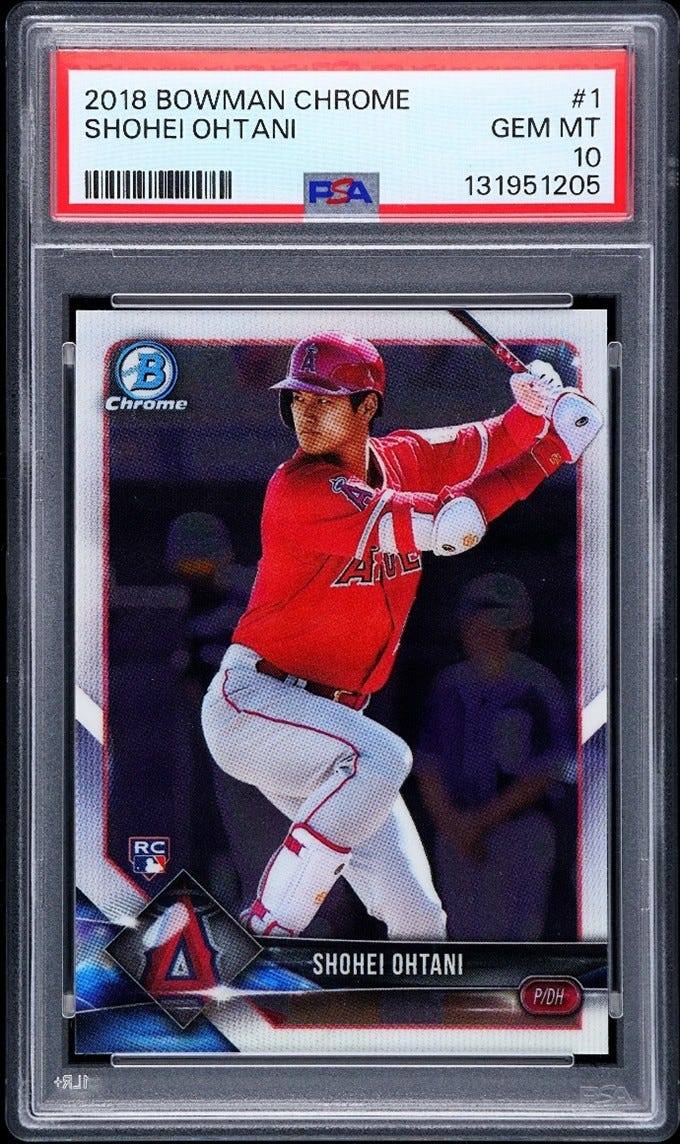
Look at the values of the PSA 10 2018 Shohei Ohtani Bowman Chrome 1 Rookie Card over the past year and a half:
April 2024: $725
April 2025: $1,050
Sept 2025: $1,800
Dec 2025: $2,850
This is a card we bought quite a few of in 2025. At various points, we thought about not buying more of this card because it was already up a ton, in spite of strong expected profitability based on the math. If we had done this, we would have missed out on a lot of profit.
This has led us to what I think is an important lesson. Generally speaking, I try not to guess which cards will go up or down in value. I just buy what the math says is profitable.
Looking at our final results on Ohtani, in total we have bought and sold 12 cards in 2025, mainly Bowman Chrome Base Rookies and Topps Chrome Refractor Rookies.
Total Cards: 12
Gem Rate: 91%
Total Purchase Price: $3,643
Total Profit: $7,798
ROI: 214%
Huge wins like that make up for the times where the hype flames out (I’m looking at you Pete Crow-Armstrong and Jac Caglianone).
2. Following the Math: New Product Releases
The trickiest part about buying new product is that as supply reaches the market, prices fall. But with just two simple adjustments, these cards can be very profitable.
Delayed Buying: We start buying about one month after the first PSA 10 sells on eBay. This delay allows the prices to settle so we don’t buy at the very top of the market.
Market Adjustments: We reduce the PSA 10 and PSA 9 value of each card by about 25% for our Expected Value calculations. For example, if a PSA 10 is currently selling for $1,000, we run our math as if it were selling for $750. You can see our previous post for a deeper dive into this calculation here.
Example: 2024 Football Rookie Cards
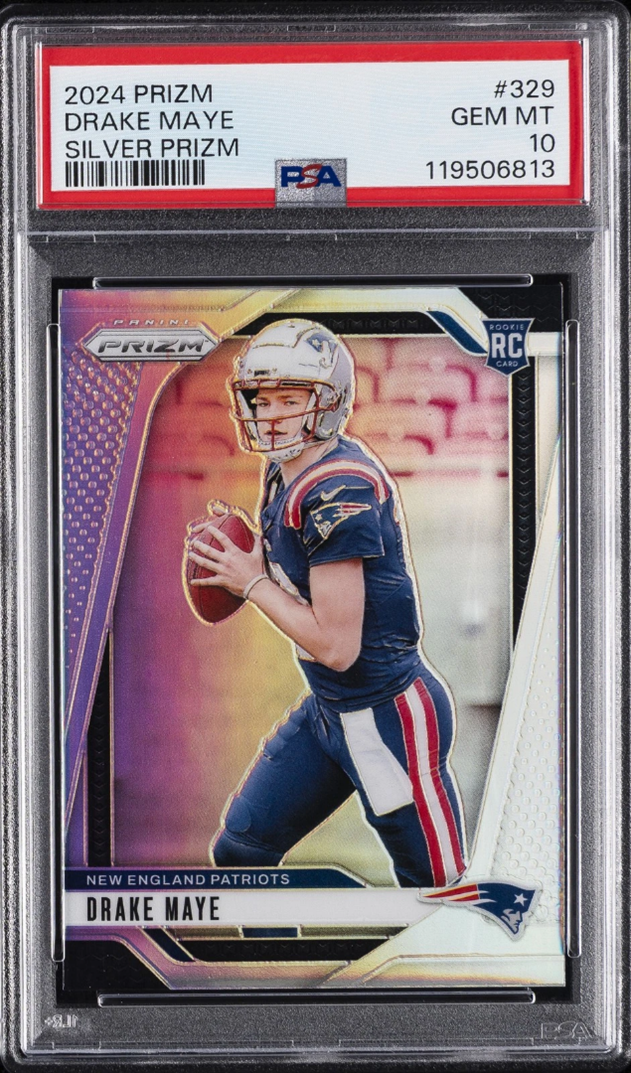
In 2025, we bought 2024 football products aggressively based on the principles listed above. In total we bought 30 cards, mainly the rookie quarterbacks from this draft class: Jayden Daniels, Drake Maye, Michael Penix, JJ McCarthy, and Bo Nix. We also bought across various product lines, including Phoenix Color Blast, Prizm, Downtown, and Topps Chrome.
Here is a brief summary of our results:
Total Cards: 30
Gem Rate: 57.7%
Total Purchase Price: $9,944.60
Total Profit: $3,232.43
ROI: 32.50%
Not only did these cards generate strong returns on investment, but they were also some of the most abundant cards on the market. The combination of strong profits and abundant supply is exactly what you need in a reselling business.
Final Takeaways
While many resellers avoid buying “risky” cards, our philosophy is that these are actually the most profitable cards you can buy, if you are disciplined about following Expected Value systems.
Supply is Your Friend: Both new releases and “hyped” players offer the high volume of raw cards necessary to scale a resell business.
Popular Cards Often Generate the Highest Profits. Don’t shy away from them.
Diversifying Your Inventory: We protected against risk by buying inventory across different sports, players, and product lines. For example, we try not to let one individual player make up more than 10% of our invested capital.
Win Big and Lose Small: Some players and product lines will generate losses or lower than expected profits. Understand that big wins and small losses tend to average out to solid results.
Calculated Risk + Strict Math + Diversification = Sustainable Profit. Don’t try to predict the future. Buy what the math tells you is profitable, adjust for falling markets when necessary, and let the law of averages work in your favor.