


This is a tutorial on finding the Expected Value (EV) of grading a card. We find that this is one of the most important concepts to buying and grading cards profitably, which led us to strong success in 2025 with a net profit margin of 24% and total ROI on card purchases of 35%.
The idea is that we look for cards where the EV of grading the card is significantly higher than the cost of buying it. While a positive EV does not guarantee that every purchase will be profitable, it does mean on average your purchases will be profitable if you’re buying 10s, 100s, or 1,000s of cards.
To give you a short roadmap before we start:
Expected Value = PSA 10 Value x Gem Rate + PSA 9 Value x (100% - Gem Rate) - Grading Costs - Selling Fees
Expected Profit = Expected Value - Purchase Price
Note: This combined with our Complete Guide to PSA Grading are the two articles meant to give readers the foundational background to grade cards profitably. I highly recommend you read both of these articles.
Expected Value in Card Grading: The Key to Profitability
Expected Value is a probability based measurement of the value of something. Let’s say you have a lottery where you have:
A 50% chance of winning $5
A 50% chance of losing $1
The Expected Value is equal to:
$5 x 50% + -$1 x 50% = $2.00
This is the perfect analogy for card grading. The 50% chance of winning money is similar to the profit you make on a PSA 10. The 50% chance of losing money is equivalent to taking a small loss on a PSA 9. Expected Value helps you to make sure that you make money, even when taking losses on PSA 8s and 9s.
Finding the Market Values
We’ll start by finding the market value of the cards. We generally only use the PSA 10 value and the PSA 9 value, and ignore the possibility of getting a PSA 8 or worse. We do this for the following reasons:
We buy mostly Ultra Modern cards. These have a very high probability of grading as a 9 or 10.
We aim for a minimum of a 25% ROI, which gives us a margin of safety for cards that grade below a PSA 9.
You can find these market values using eBay’s Product Research tool or market research services like CardLadder.
Gem Rate & PSA 9 Rate
We look at the Gem Rate as an estimate for how often a card will grade as a PSA 10. It’s simply the amount of times a card has graded as a PSA 10, divided by the total graded population. You can find this number on the PSA app or on gemrate.com.
Gem Rate = Total PSA 10s / Total Graded Population
And because we usually assume everything will grade as a PSA 10 or a PSA 9, the PSA 9 rate is:
PSA 9 Rate = 100% - Gem Rate
Expected Value Before Fees
EV Before Fees is a simple weighted average of the PSA 10 Value and PSA 9 Value, based on the Gem Rate. The formula is shown below.
EV Before Fees = PSA 10 Value x Gem Rate + PSA 9 Value x (100% - Gem Rate)
Calculating Expected Selling Fees
Selling fees will depend on where you sell your cards. We use PSA Vault for consignment, but eBay and other platforms will have different rates.
PSA Vault Consignment Rates:
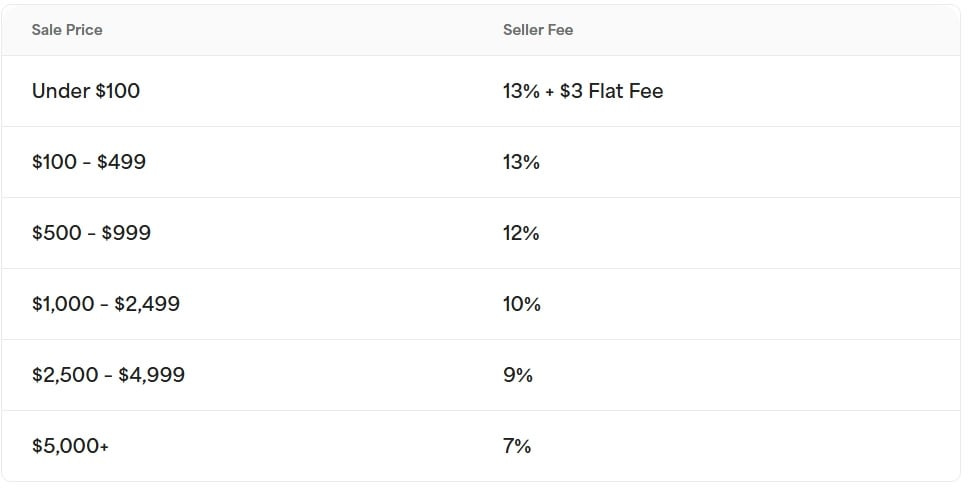
To calculate Expected Selling Fees, multiply EV Before Fees by your fee percentage:
Expected Selling Fees = EV Before Fees x Fee Percentage
If a card falls into different fee tiers depending on whether it grades as a PSA 10 or 9, we just average the two rates and use that as our estimate. For example, if a card will have a 10% fee as a PSA 10 and a 12% fee as a PSA 9, we’ll just use 11%.
Expected Grading Costs:
Upcharges are a bit tricky. When you submit a card to PSA, you choose a service level with a corresponding Maximum Insured Value. After grading, PSA re-estimates the card’s value based on its grade. If a card comes back as a PSA 10 and its value exceeds your chosen tier’s Maximum Insured Value, PSA upcharges you to the next tier.
We generally submit at the tier that covers the card’s PSA 9 value, which means we often get upcharged when cards gem.
Below you can see a table of PSA’s service levels and the associated Maximum Insured Value (underlined in red) with each:
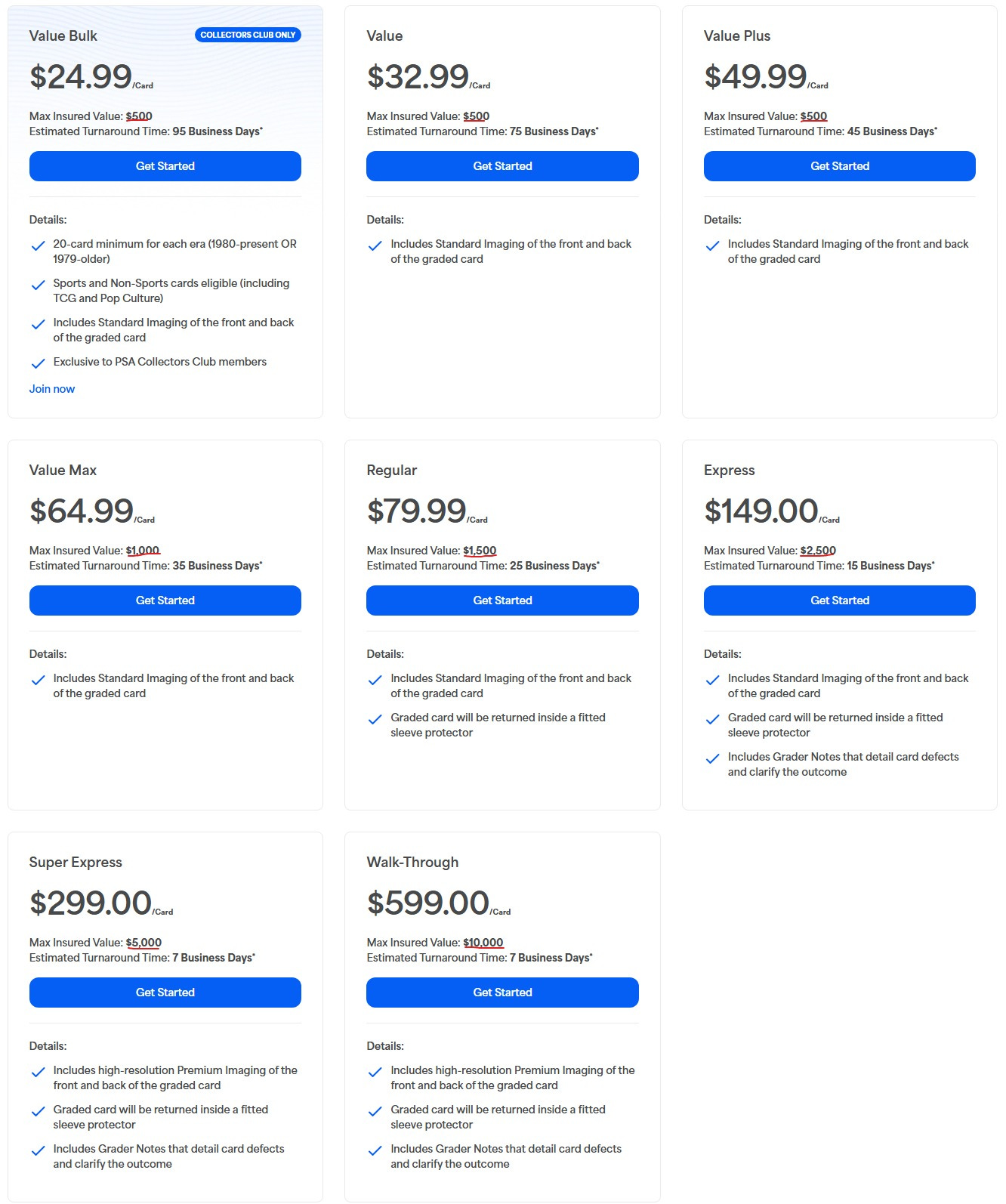
Here’s a simple example:
Submission Tier: Value Max
Card Value (ungraded): $650
Max Insured Value: $1,000
Initial Submission Cost: $64.99
Card Value (PSA 10): $1,250
Updated Submission Cost: $79.99
Amount of Upcharge: $79.99 - $64.99 = $15.00
You’ll also need to estimate round-trip shipping. If you skip insurance on outbound shipments, $10 per card is a reasonable estimate. If you add insurance, it’s typically around 1% of the package value.
With this in mind, we calculate Expected Grading Costs as follows:
Expected Grading Cost = Initial Grading Cost + (Gem Rate x Upcharge Amount on PSA 10*) + Shipping Costs
*If you submit with a Maximum Insured Value greater than the value of a PSA 10, this amount will be zero.
Note: PSA increased their grading fees on February 10th, 2026. This guide has been updated to reflect the change.
Expected Value (EV): When to Buy and When to Pass
This is the straightforward part. Total EV is calculated by taking EV Before Fees and subtracting Selling Fees and Expected Grading Costs:
EV = EV Before Fees - Selling Fees - Expected Grading Costs
Expected Profit is just EV minus the cost of buying the card:
Expected Profit = EV - Purchase Price
And Return on Investment is:
ROI = Expected Profit / Purchase Price
For raw cards over $200, we target a 25% or higher ROI. For raw cards under $200, we target a minimum Expected Profit of $45. If a card doesn’t clear one of these thresholds, we pass.
And that’s all. Thanks for reading, and I hope you find this helpful in your own card buying or when reading future posts here!