


This post is going to go through a couple of important concepts in card grading, Gem Rates and Multiples. These are extremely helpful because they provide a shortcut to decide if a card or card set will be profitable to buy. In the simplest terms, a high Gem Rate and high Multiple both are good for profitability, and generally the most profitable cards will have both.
Note that we primarily buy ungraded Ultra Modern sports cards and Pokémon cards in the $100 - $1,000 range. The following analysis is mainly based off these cards (although it mostly applies to Modern and Vintage as well).
With that said, let’s get into the specifics of what each of these numbers mean.
Gem Rates
I’ve already discussed Gem Rates extensively in this newsletter, but I will redefine it here for anyone who’s unfamiliar.
Gem Rate: The amount of times a card has graded as a PSA 10, divided by the total graded population. You can find this number on the PSA app or on gemrate.com.
For example, if a card has been submitted 10,000 times and has graded as a PSA 10 5,000 times, the Gem Rate is:
Gem Rate = 5,000 / 10,000 = 50%
We use this as a measure of the probability a card will grade as a PSA 10. Remember, to actually reach these results you need to have a strong pre-grading process. You can find our guide to PSA grading here.
With that said, there are two main things to know about Gem Rates. One is that they are usually (but not always) consistent across sets. Meaning that if the Gem Rates for 2023 Prizm Basketball cards are good as a whole, you can assume that the Gem Rates for each individual card in the set is also good.
Note that there are exceptions to this. For example, 2024 Football Micro Mosaic set grades around 49.2%, but the Bo Nix Micro Mosaic card in particular grades at 9.79%.
The second important thing to know, is that high Gem Rates lead to higher profitability. To understand why, remember that in a grading business, we make our money when a card grades as a PSA 10. So if a card grades as a PSA 10 more frequently, this means we have a higher chance of making profit.
Taking a simple example, let’s look at 2 cards and evaluate their EV Before Fees and Grading Costs (you can find a refresher on how to calculate EV here).
Card 1:
PSA 10 Value: $400
PSA 9 Value: $200
Gem Rate: 50%
EV Before Fees and Grading Costs: $400 x 50% + $200 x 50% = $300
Card 2:
PSA 10 Value: $400
PSA 9 Value: $200
Gem Rate: 75%
EV Before Fees and Grading Costs: $400 x 75% + $200 x 25% = $350
You’ll notice that with all other values held equal, increasing the Gem Rate of the example card increased the Expected Value of that card.
Multiples
This is something I haven’t discussed in previous posts, but hopefully you’ll quickly see how related it is to Expected Value.
Remember, we are aiming to grade cards as PSA 10s because PSA 10s are worth more than PSA 9s and ungraded cards. The Multiple is a measure of that. More specifically, here is the definition of the Multiple.
Multiple: The value of a PSA 10 of a certain card, divided by the value of an ungraded copy of the same card.
PSA 10 Value: $1,000
Ungraded Value: $500
Multiple: $1,000 / $500 = 2.0x
This means that the higher the multiple, the more profitable it will be to buy an ungraded card. Here’s a simple example.
(As a side note, it’s helpful to know that for Ultra Modern cards, the PSA 9 value tends to be similar to the ungraded value.)
Card 1:
Raw Value: $100
PSA 10 Value: $400
Multiple: 4.0x
Increase in value from PSA 10: $300
Card 2:
Raw Value: $100
PSA 10 Value: $200
Multiple: 2.0x
Increase in value from PSA 10: $100
As you can see, receiving a PSA 10 Card 1 leads to a much greater increase in value than Card 2.
Average Multiples
We find that the average multiple tends to be around 2.0x, but a lot of the most popular product lines are slightly higher. Prizm sports cards tend to consistently be above 2.0x for example, and can be as high as 5.0x to 7.0x, especially in years where Gem Rates are low.
We also find that Multiples, like Gem Rates, tend to be fairly consistent across sets. For example, if you notice that 2024 Prizm Football cards have Multiples in the 4.0x to 6.0x range, it’s likely that this roughly applies to all the cards in the set.
You also can use the Multiple as a short cut to estimate values of cards that have few comps. For example, if I’m looking at a Select Variation /25 (i.e. with only 25 copies available), and the only sales I can find are of ungraded cards, I can use average multiples to estimate the PSA 9 and PSA 10 values.
And one final point here, multiples tend to be low on sets that aren’t mainstream. Think of the Wild Card autos and similar Ultra Modern sports cards not produced by Panini, Upper Deck, or Topps.
Bringing Gem Rates & Multiples Together
That brings us to another important point. Multiples tend to be higher (although not always) when Gem Rates are lower. For example, the Prizm cards referenced above with high Multiples are from years when Gem Rates were relatively low (around 20%).
As a result, to buy cards profitably, you want to have the right balance between high Gem Rates and high Multiples. Cards with one or the other can be profitable, and cards with both are almost always profitable.
Here’s a simple profitability table that illustrates this point.
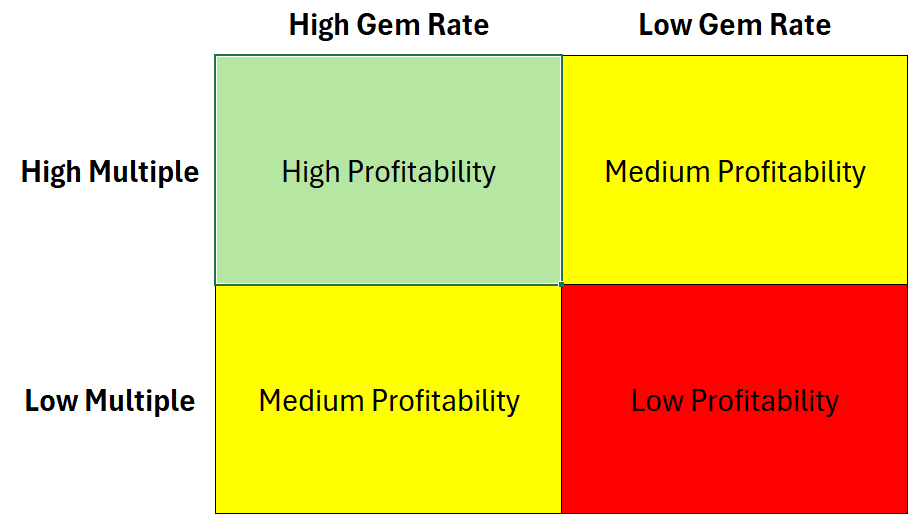
I want to emphasize, this is not a replacement for calculating Expected Value. This is a shortcut to help you decide which cards are worth evaluating in the first place.
Here are some examples of each:
High Gem Rate / High Multiple:
The 2023 Prizm Basketball has solid Gem Rates (50%+) and solid multiples (2.5x+). Therefore, I’m going to look at the Expected Value math on these whenever I can. The practical application of this is you want to be targeting a lot of Victor Wembanyama Prizm cards, especially the parallels.
High Gem Rate / Low Multiples:
The 2024 NFL Phoenix Color Blast cards had very high Gem Rates (around 70%) and average to slightly below average multiples (around 2.0x or less). This is an example of a product line that fits into this category and is often profitable.
Low Gem Rate / High Multiples:
The 2024 NFL Prizm cards had low Gem Rates (around 20%) but very high multiples (around 5.0x). This is an example of a product line in this category that also has been often profitable.
Low Gem Rate / Low Multiples:
The 2024 NFL Donruss Downtown cards have low Gem Rates (around 30%) and low multiples (around 2.0x). This is an example of a product line that is rarely profitable. Can you tell we buy a lot of football cards?
Final Takeaways
We are generally aware of the players (and Pokémon) that we want to buy. In general, we’re looking for the most popular cards, so think Drake Maye, Shohei Ohtani, Victor Wembanyama, Pikachu, Charizard, and Umbreon. You can find more on our philosophy on what cards you should buy to grade here.
Combining this with having a general knowledge of Gem Rates and Multiples, you should have a pretty good idea of what cards will be profitable to buy, without having to calculate Expected Value on everything you see. This is why we also track the Gem Rates and Multiples of new sets closely, to determine if we want to be buying them or not.