



I’ve been reading and enjoying The Hobby Wire’s Collector Case Study posts for a while now, so I decided to ask them a question. If you had to make a long term investment in any young player in sports right now, who would it be.
His answer: Gunnar Henderson.
Below, The Hobby Wire will explain why Henderson is an attractive long term hold. After that, I’ll discuss why I love this choice; then look at the math behind grading these cards, identify realistic entry points, and discuss a few different exit strategies you can use.
The Player — The Hobby Wire
Baseball season is right around the corner. Spring Training is a couple weeks away, then the WBC. Blink and it’s March 25th. This is typically when investors start hunting for quick flips to buy low during the offseason.
Instead of the quick flip, 760cards asked us a different question. Who’s a player we’d buy right now with the intention of holding long term? There are obvious answers here — Ohtani, Judge, Bobby Witt Jr. But all of those players’ cards are coming at a premium these days. Instead, we’re setting our sights on Gunnar Henderson.
Why Gunnar?
It wasn’t that long ago that the former Rookie of the Year finished 4th in AL MVP voting after a 37-homer 2024 campaign. In just over three seasons, Henderson has already racked up a ridiculous 21.4 WAR.
Here are the reasons we think Gunnar is a solid buy right now.
Career Projections
At The Hobby Wire, our projection model is always a work in progress. For baseball players, we start by looking at how often a player is actually on the field, calculating their average games played per season. From there, we apply that rate to their 162-game pace to estimate what a typical season might look like. Stack those seasons together, and you get a rough idea of the kind of career a player could realistically put together. By no means is this a crystal ball, just a framework to help ground the conversation. But if Henderson continues producing anywhere near his current pace, the numbers get eye-opening fast.
4 Seasons (Current Stats) WAR 21.4 • Hits 508 • HR 86 • RBI 260 • SB 62
8 Seasons (Potential Free Agency Year) WAR 48 • Hits 1,139 • HR 192 • RBI 583 • SB 138
10 Seasons WAR 61.3 • Hits 1,454 • HR 245 • RBI 745 • SB 176
15 Seasons WAR 94.6 • Hits 2,243 • HR 378 • RBI 1,149 • SB 271
20 Seasons WAR 127.9 • Hits 3,032 • HR 511 • RBI 1,553 • SB 366
The average superstar shortstop can play anywhere between 18-20 seasons. Given that Gunnar was called up at just 21 — the same age as Derek Jeter — the odds are better than most that he pushes toward the high end of that range. Don’t get too carried away with the WAR projection, though. Odds are that the defense will go once Henderson gets to his mid 30s. Even with that caveat, Henderson is still on a pace that puts the 500-home run club within sniffing distance of 3,000 hits. Those are Hall of Fame–caliber benchmarks.
Bonus Note: If Gunnar Henderson does get to free agency with almost 50 WAR, you better believe he’s in for a big payday (as well as a bump in card prices).
He Stays Healthy
Baltimore is absolutely loaded with young, star level talent. From a buying standpoint though, Gunnar’s the safest play. Samuel Basallo is selling at a premium and Adley Rutschman is close to receiving the “injury prone” label. Henderson averages about 154 games per season — not quite Iron Man territory, but he’s on the field roughly 95% of the time.
Buying the Dip
There’s no sugarcoating it: Baltimore stunk last year. The team the media pegged to be a future dynasty finished 5th in the AL East. Even Henderson had a bit of an off year. He really struggled against breaking balls, hitting only .228 against them vs .298 the year before. Despite that, he still racked up over 5 WAR.
Collectors didn’t care. The result was a broad sell-off across Orioles cards following a 75-87 season in 2025.
The Henderson Market
To get a sense of Gunnar’s market, we looked at the three most collectible cards for any modern baseball player — Their Topps Chrome Rookie Refractor, Topps Chrome Rookie Auto, and their 1st Bowman Chrome Prospect Auto — and see what love the hobby has given Henderson since he’s been called up to the majors.
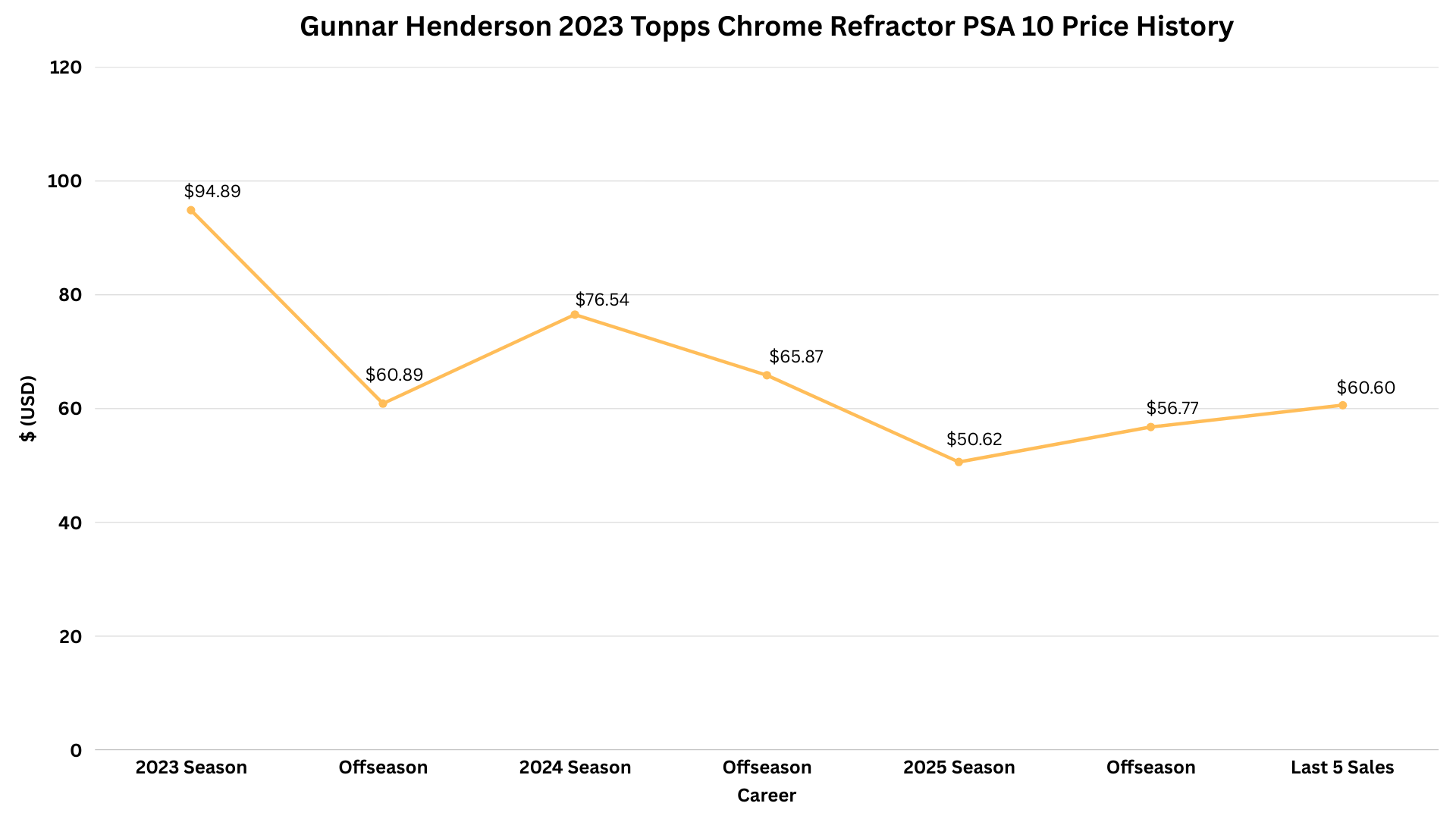
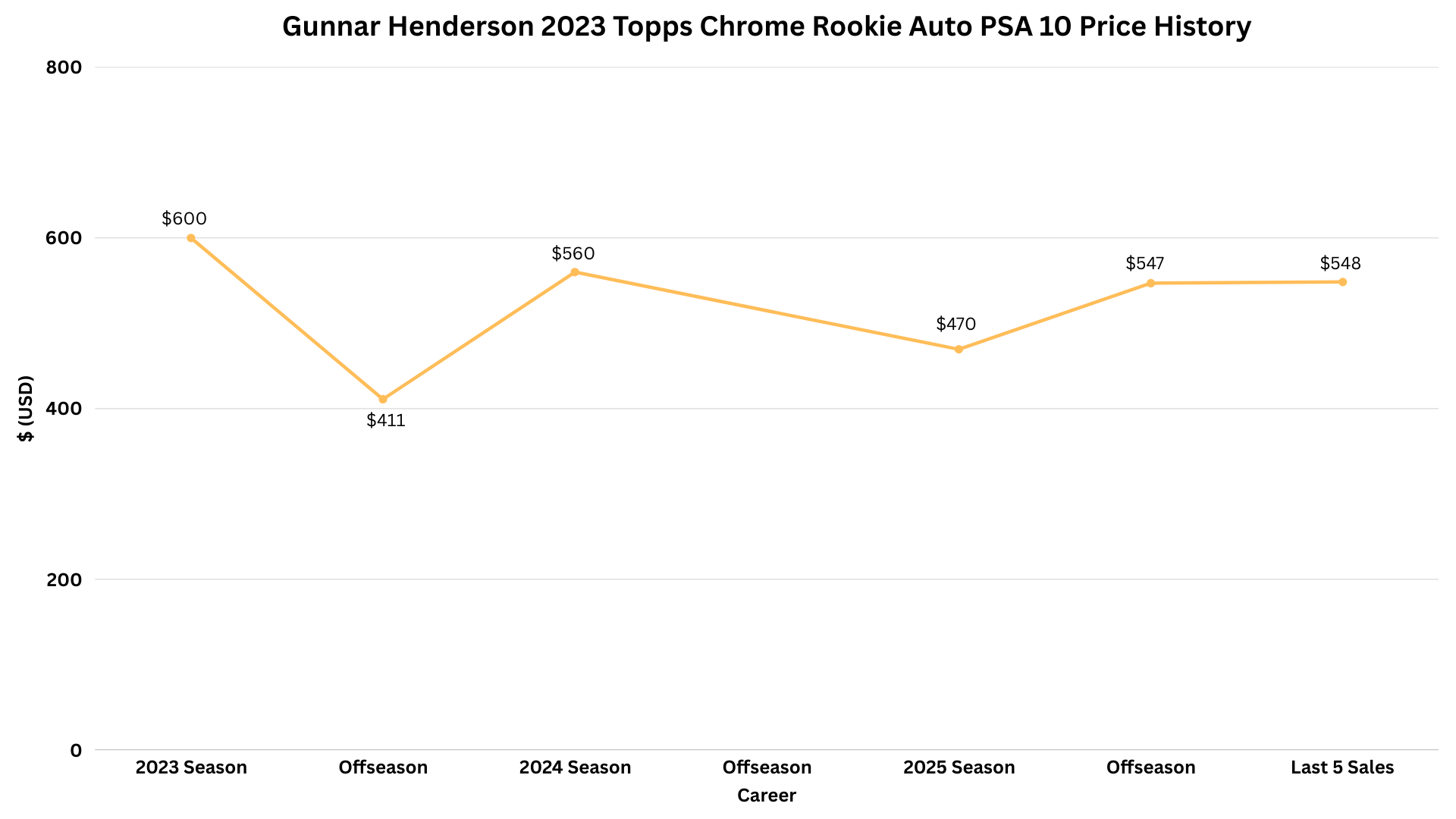
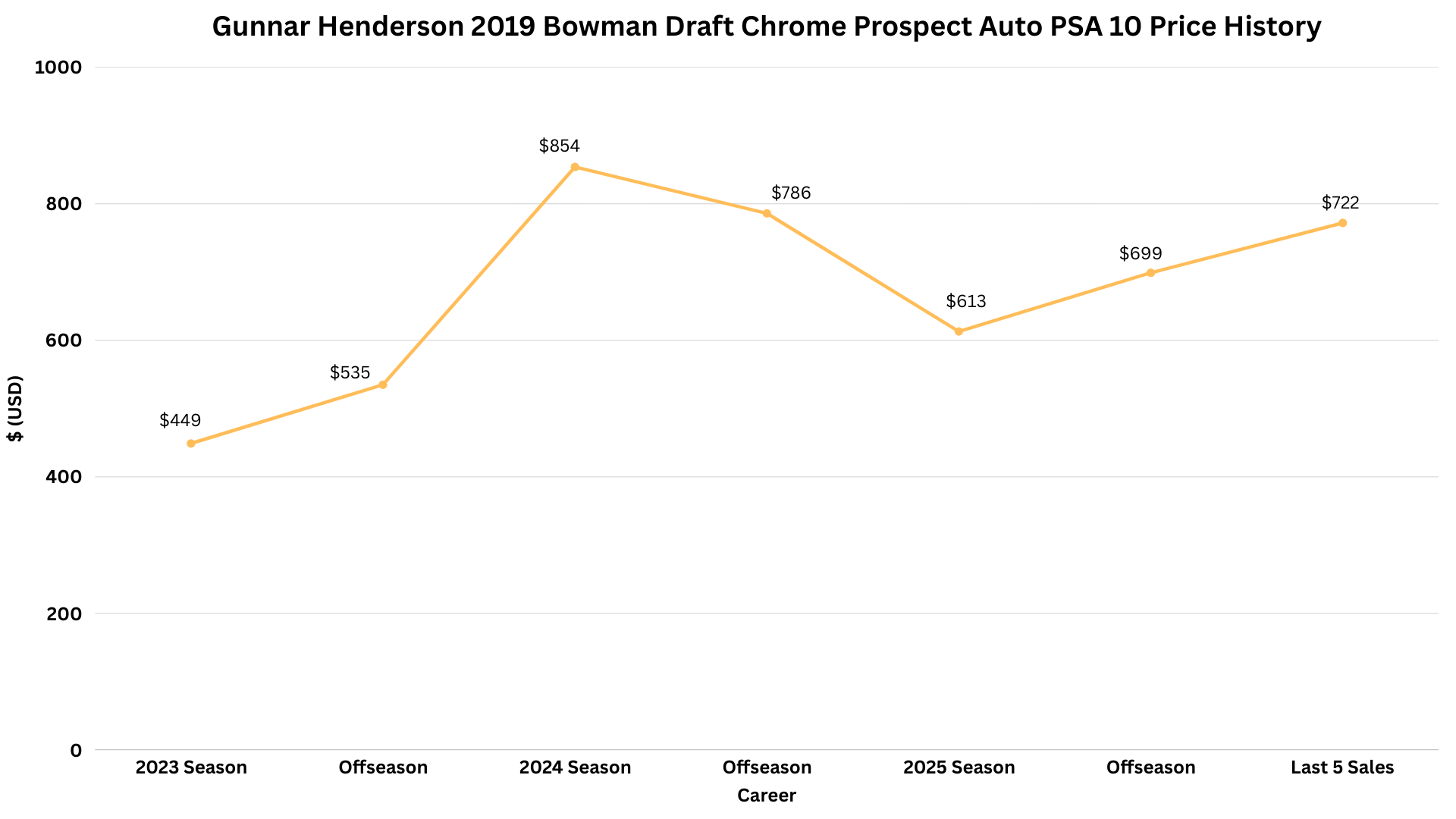
Each graph tells a slightly different story. Gunnar’s Topps Chrome Refractor was by far the most volatile. Collectors were quick to sell when things got bad in 2025. The autos, on the other hand, seem to be maintaining their value quite nicely with the Topps Chrome Auto basically showing a flat line since release and the 1st Bowman heading back towards his near-MVP peak pricing.
If you’re picking a card to stash for the long haul, the data points squarely toward the autos.
Now that we’ve outlined the player and the market, we’ll hand it back to 760 Cards to lay out the long-term game plan.
The Plan — 760cards
I really like this player choice. In fact, I think it highlights something that frustrates me about the card hobby more generally. People move on to the next big thing so quickly. Gunnar Henderson is a proven stud in the MLB, with legitimate upside to have a high level, Hall of Fame worthy career. And yet, many unproven prospects are selling for more than Gunnar. This seems like a mistake. When thinking about the long term viability of the hobby, we’ve already seen Henderson demonstrate a unique blend of consistent All-Star level production and MVP-caliber upside. That makes him more likely to be one of the top players of this generation than any unproven prospect.
For a long term hold, I think this is a great choice.
As far as grading goes, let’s look at the math and break down what are good entry points to profitably grade these cards. The Bowman Chrome Refractor (non-auto) card is a bit too inexpensive to be worthwhile to grade, so we will instead focus on the TC Rookie Auto and the BC 1st Auto.
And as a reminder, we’ll be looking at the profitability of these cards based on Expected Value. You can find a guide to how we calculate this here.
Grading Analysis
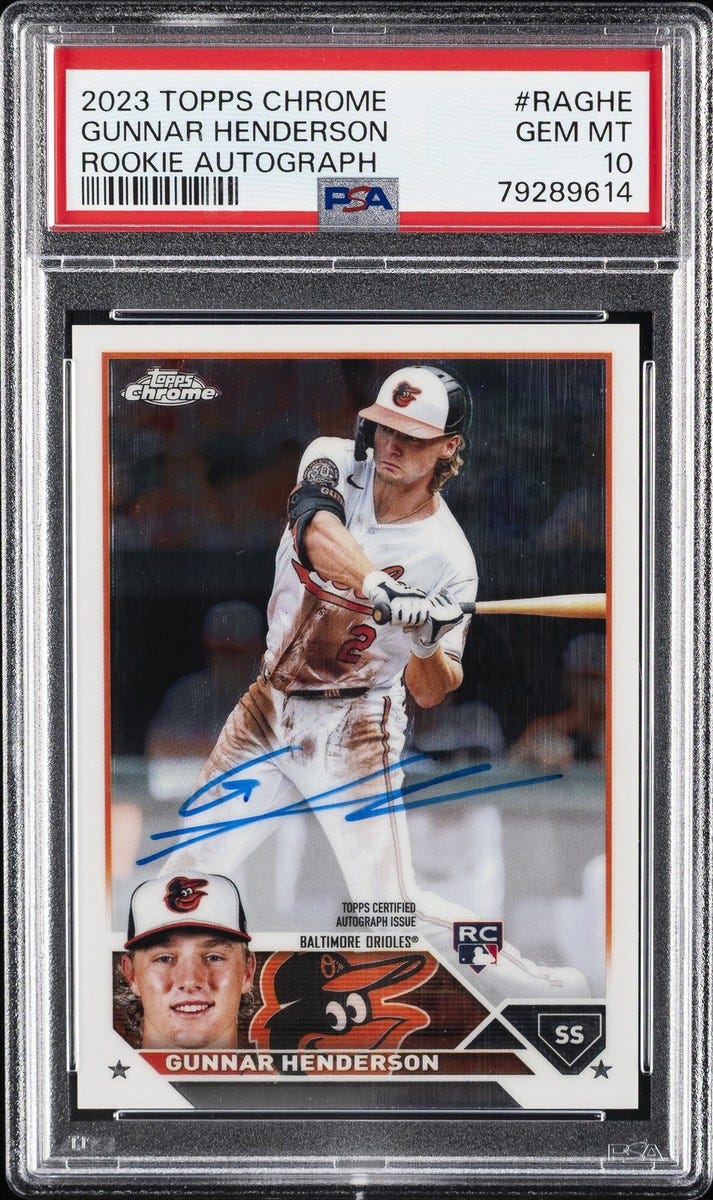
2023 Topps Chrome Gunnar Henderson Rookie Auto #RA-GHE
Market Values
PSA 10 Value: $600
PSA 9 Value: $200
Gem Rate: 43.5%
Expected Value
PSA Grading Service: Value Plus ($44.99 initial cost)
EV Before Fees: $600 x 43.5% + $200 x 56.5% = $374
Expected Grading Cost: $44.99 + $7 (shipping) = $52
Expected Selling Fees (12.5%): $374 x 12.5% = $47
Expected Value: $374 - $52 - $47 = $275
Target Purchase Price
Max Price to Pay (for 15% ROI): $275 / 1.15 = $239
Raw Card Value: ~$200
One of the challenges of getting this card is there’s not many of them out there. There are only 46 total PSA graded cards, although some of the parallels are options as well. Weirdly, some of the parallels are actually more abundant. For example, the Purple Speckle /299 variant has 150 total PSA graded cards.
Normally, I target a 25% Expected ROI on cards I grade, but in this case, I lowered the target to 15% since we are looking to invest. This means you can pay up to $239 for the card, which is a very reasonable price. Again, the challenge will be actually finding supply of this card. Luckily, the numbered parallels have a similar market and can also be found for around $200.
2019 Bowman Chrome Draft Gunnar Henderson Auto #CDA-GH
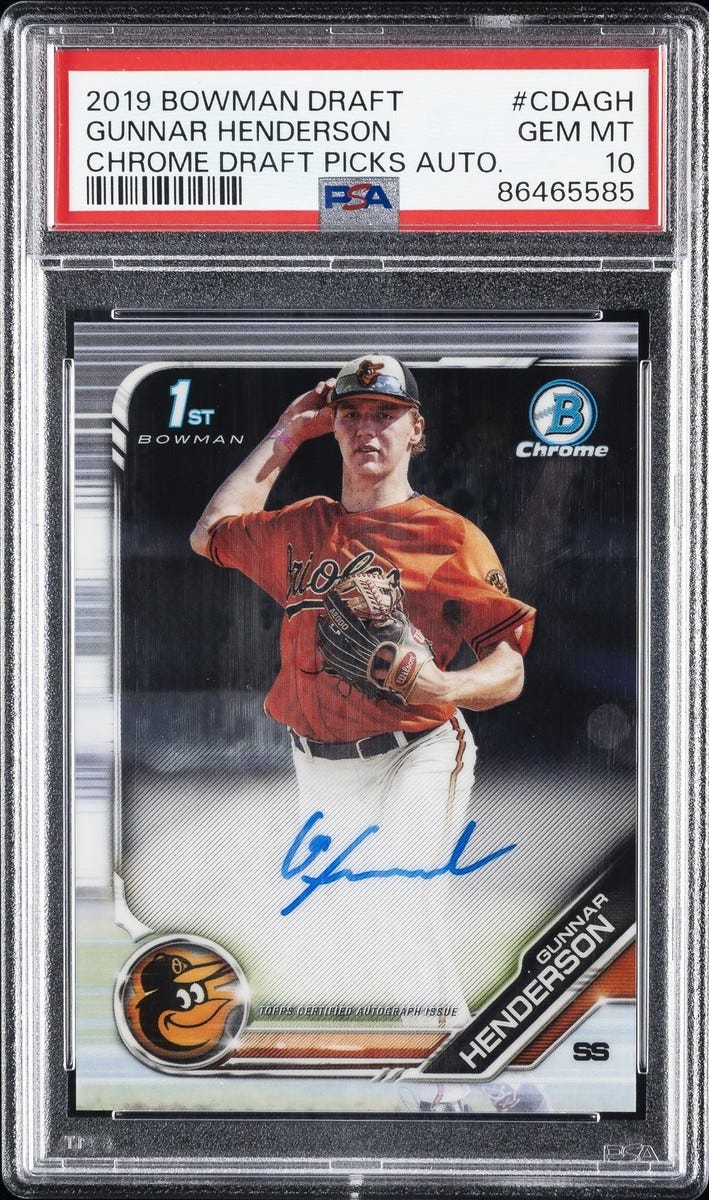
Market Values
PSA 10 Value: $690
PSA 9 Value: $330
Gem Rate: 51.1%
Expected Value
PSA Grading Service: Value Plus ($44.99 initial cost)
EV Before Fees: $690 x 51.1% + $330 x 48.9% = $514
Expected Grading Cost: $44.99 + $15 x 51.1% (upcharge) + $7 (shipping) = $60
Expected Selling Fees (12.5%): $514 x 12.5% = $64
Expected Value: $514 - $60 - $64 = $390
Target Purchase Price
Max Price to Pay (for 15% ROI): $390 / 1.15 = $339
Raw Card Value: ~$265
Surprisingly, this card seems like it’s easier to find than the Topps Chrome Rookie Auto, as there’s over 1,000 copies graded. And it looks like a profitable card to grade if you can find it, as the raw value of $265 is significantly lower than the price we can pay to grade it ($339). Of the two options presented, I’d prefer to target this card to grade, although parallel cards for both the Topps Chrome Auto and the Bowman Chrome Auto are options as well.
Possible Exit Strategies
For those who have been reading my articles, you know I focus on the short term flips, but I want to identify some other strategies you can use. Note that these are a bit out of my wheelhouse, but I still want to share some thoughts here.
1. Short Term: Grade and Flip
This is the model I use in general, although I usually just buy based off expected value and don’t consider the market movements that may occur. But this is a good short term approach that still allows you to invest in a player. It takes about 4-5 months to buy, grade, and sell a card, giving you about a 4-5 month investment into Gunnar. You can also use a blended approach where you buy and grade the card, but then hold it for a longer period using one of the strategies below.
2. Medium Term: Waiting For a Sell Window
Given that Gunnar has elite upside in any given season, and the Baltimore Orioles are a young and talented team coming off a disappointing season, this is a good medium term buy-low candidate. I think it could make sense to buy (and grade if you want) and wait for a sell window. Any combination of the following variables could give you a great sell window: an MVP caliber season, the Orioles making a playoff run, and/or a general boom in the baseball card market. I tend to try to stay disciplined when it comes to business decisions, so if you pick a strategy like this, I’d suggest laying out a specific plan and sticking to it.
3. Long Term: Buy and Don’t Sell
This is the approach I had in mind when we first started this post, and this is why I loved the player choice. To me, long term viability in this hobby requires a player to play at a Hall of Fame level, and the players who appreciate massively are the all-time legends of the game. Given Gunnar’s age, talent, and early career performance, I think the sky is still the limit for his upside. I see a long term hold (20+ years) as a risky strategy here, but a fun one that has the potential for huge long term returns.
Thanks for reading and thanks again to The Hobby Wire for his great work on this post!
I could get this parallel for $85. Would you take that if you were in my shoes?
https://ebay.us/m/3BxOZq