


Last week, I wrote an article explaining how to win cards on auction (which you can find here). This week, I’ll walk you through the process behind a card we actually won on auction, step by step.
It’s a fun one too: the first Jordan Walker card we’ve bought. Walker is in the midst of a breakout season, meaning he’s exactly the type of player we like to target.
Let’s dive into it.
Step 1: Identify the Target
Card Name: 2023 Topps Chrome Jordan Walker Auto Orange Wave /25
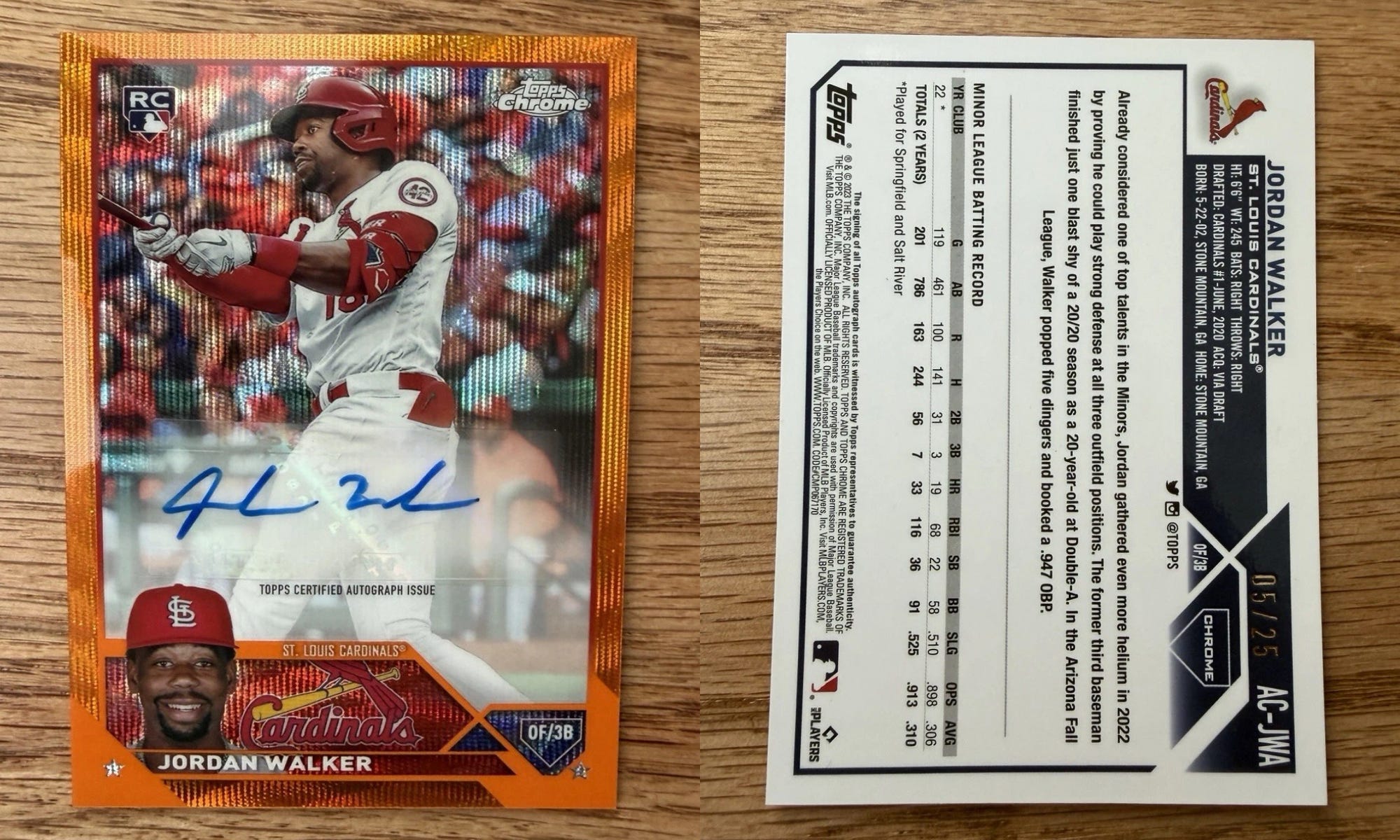
First of all, Jordan Walker is a guy that we flagged in our market research as a profitable target, and added to our BCG Auctions Tracker tool. This means that when we saw this card, we knew to investigate it further.
Second, the condition on this card looks very good. The card is centered, corners are sharp, and there are no obvious defects.
Lastly, I took a quick glance at sales to make sure that the price was reasonable. When I looked, the auction was at $200, and the most recent PSA 10 sale was over $800.
Step 2: Ask The Seller Questions
For these Topps Chrome cards, the front material is very sturdy, but the back corners tend to be soft at times. We decided to ask the seller for closeup pictures of the back corners to get a better feel for the condition, but we could have bid without them.
Sometimes getting these extra pictures gives you the confidence to assume that a card has a 50% chance of gemming, instead of 40%. This often can be the difference between winning and losing an auction. In other cases, additional pictures prevent you from buying a card that has a defect that you didn’t catch from the original listing.
In other words, it’s smart to ask questions within reason, as long as you’re respectful of the seller’s time.
Step 3: Assess The Market
Jordan Walker is an interesting player to evaluate. Given that his market has increased dramatically over the last few months, really any sale that’s more than a few weeks old isn’t helpful.
We went looking for this card on eBay Product Research to see what comps we could find. Sometimes there’s an art to creating the right search terms here to show the cards you want to see. In our case, we used the search term: “2023 Jordan Walker Topps Chrome Auto /25”. I would have been happy to get results for similar TC Autos also numbered /25, even if it wasn’t our exact card.
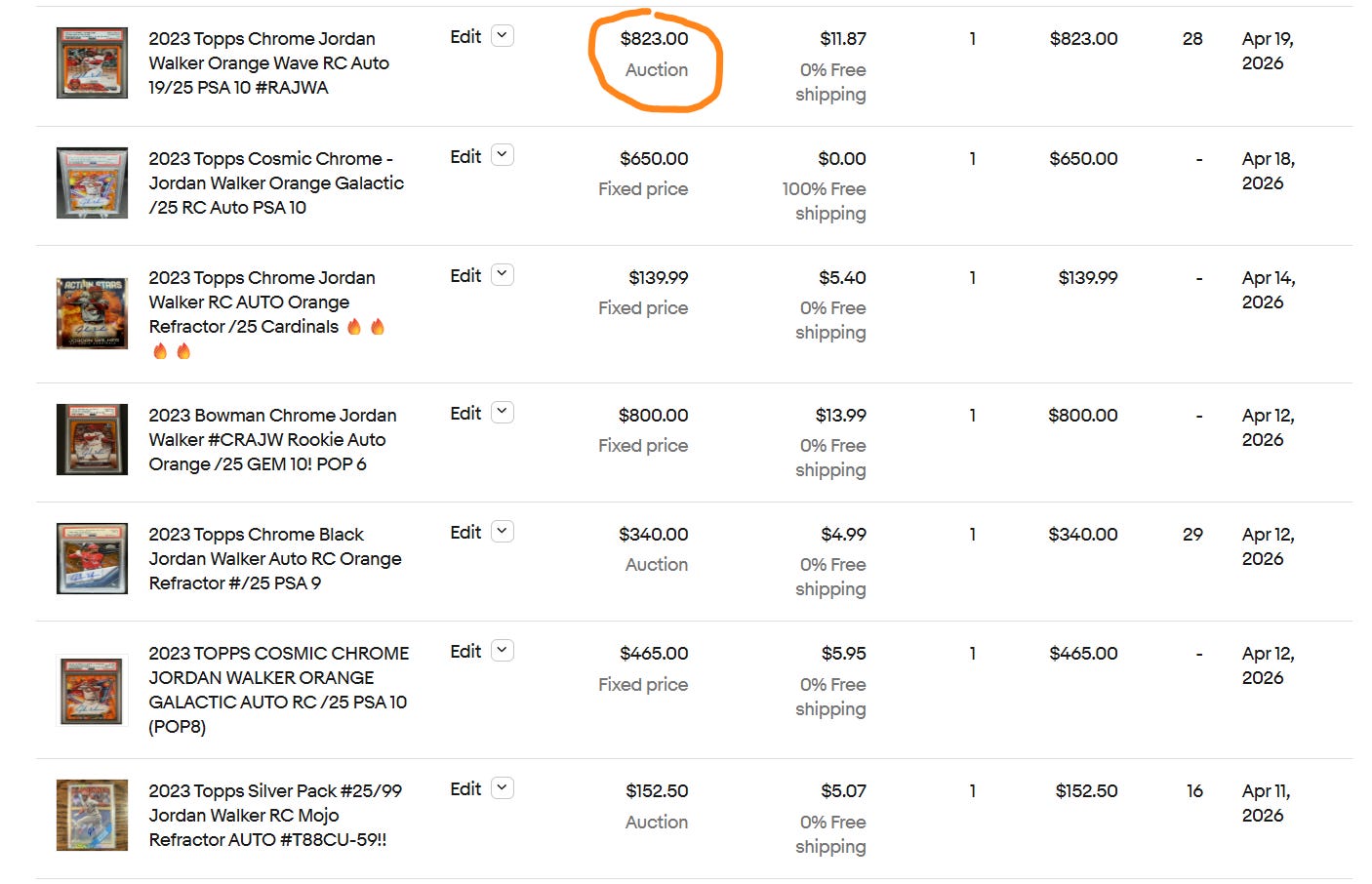
The top card on the list was the only relevant result, with our exact card selling for $823 as a PSA 10 just a day before this auction was set to end. Normally bidding on a card with just one comp to go off of can be dangerous, but I felt like I had a good feel for this market from doing market research in weeks prior.
Step 4: How To Handle Limited Comps
As mentioned above, this card did not have many recent sales, which brings about a key problem. How do you determine the PSA 9 Value?
If you remember from our Complete Guide to Expected Value, there are 3 numbers you need to calculate the value of a card: PSA 10 Value, PSA 9 Value, and Gem Rate.
Expected Value = PSA 10 Value x Gem Rate + PSA 9 Value x (100% - Gem Rate) - Grading Costs - Selling Fees
But in this case, there was nothing available to determine the PSA 9 value, so we used a shortcut. To do this, we estimate a multiple and use this to calculate the PSA 9 value based on recent PSA 10 sales. You can read a bit more about Gem Rates & Multiples here.
In this case, we decided to use a 2.35x multiple, meaning that we assumed that a PSA 10 is worth 2.35x more than a PSA 9 of this card. That number is more of a feel thing than an exact science, but we’ve found this number tends to be roughly accurate for Topps Chrome Rookie Autos and Bowman Chrome First Autos. But at the end of the day, this is a rough estimate meaning that there is a bit of additional risk with bidding based on these numbers.
In total, to calculate our PSA 10 and PSA 9 values based on just our one recent sale shown above, we estimated the PSA 10 value at $800, and the PSA 9 value as $800 / 2.35 = $340. Note that we went a bit below the recent PSA 10 sale of $823 to be conservative.
Step 5: Find the Gem Rate
This is one of the easy parts. For this we go to gemrate.com and searched for “Jordan Walker Orange Wave Auto”. You can see the exact results of this search at this link.
We found that the Gem Rate was 57.1%. Normally we look at the card’s condition and adjust our Expected Gem Rate for our specific card a bit above or below the average, but in this case, we felt that 57.1% was a good estimate based on the condition of our card.
Step 6: Calculate Max Bid
At this point we have all the numbers we need to calculate our maximum bid.
PSA 10 Value: $800
PSA 9 Value: $340
Gem Rate: 57.1%
Following the formula from Step 4, we find that the Expected Value of this card is about $466. From here, we divide by our desired return on investment to find our Max Bid.
Target ROI: 25%
Max Bid: $466 / 1.25 = $373
Following this process, we placed a bid for $373.
Step 7: Sometimes You Win
In this case, we got lucky, winning this auction for $296.52. This means that our Expected Profit is equal to the Expected Value less our purchase price.
Expected Profit: $466 - $296 = $170
The process here isn't complicated, but it does take repetition since you'll lose more auctions than you win. We win roughly one in every five to ten bids, and some of the cards you do win won't gem. That’s the nature of it, although the EV approach means that the cards that do gem should make enough money to pay for the ones that don’t.